
What the EU Digital Product Passport Will Actually Require From Your Brand (2/3)
Part 1 covered what the DPP is and why it exists. This post gets operational — breaking down the specific data your brand will need to collect, verify, and maintain, and where most brands are already behind.
The information in this post reflects our understanding of the EU Digital Product Passport regulation as of the date of publication. Requirements and timelines are subject to change as delegated acts are finalized. This post is for informational purposes only and does not constitute legal or compliance advice. Please consult a qualified professional before making business decisions based on this content. For the most current information, refer directly to official EU sources at eur-lex.europa.eu and ec.europa.eu.
If Part 1 was about understanding the landscape, Part 2 is about understanding the work. Because the Digital Product Passport is not a compliance checkbox but instead a infrastructure requirement, and the gap between where most established apparel brands currently sit and where they need to be is wider than most assume.
Based on current EU studies and consultation documents, a compliant textile DPP is expected to contain approximately 25 to 35 structured data fields per product, organized across eight core categories and phased in over two stages. Here's what each category involves, what makes it difficult, and where the gaps tend to show up.
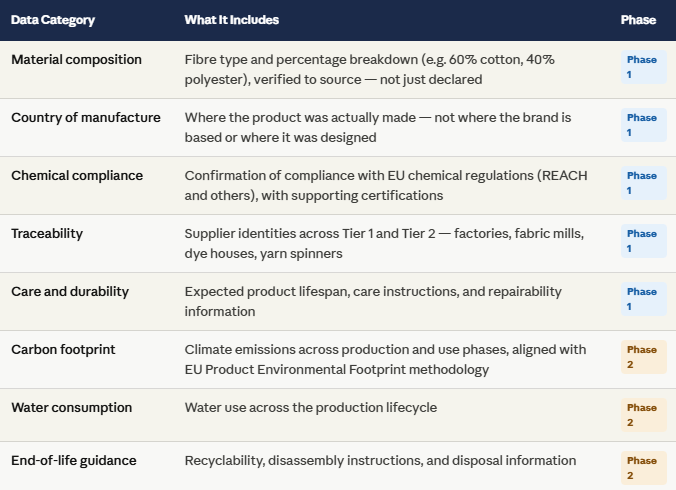
The eight core data categories:
Phase 1 requirements are expected to apply from around 2027–2028. Phase 2 requirements, which include carbon footprint and water consumption data, and end-of-life guidance, are expected to phase in between 2027 and 2030. The exact timeline will be confirmed when the apparel delegated act is adopted.
"A real DPP is roughly 25–35 structured data fields per product. Most brands assume they already have most of this data. When they audit it properly, they find they have parts of it — unverified, inconsistently structured, and held in the wrong places." -European Commission ESPR
The verification problem
The most important word in DPP compliance isn't "data." It's "verified." The EU's framework requires that the information in a DPP be auditable and traceable, not just declared by the brand. That distinction changes everything for brands that have historically relied on self-reported information from suppliers.
What this means in practice:
Fiber composition needs to be backed by lab testing or certified supplier documentation — not just the claim on a purchase order.
Chemical compliance requires current, valid certifications from suppliers — not a blanket assurance that they comply with EU standards.
Country of manufacture is straightforward for Tier 1 — your final assembly factory. It becomes complicated for brands with multi-country production chains where components are manufactured in multiple locations before final assembly.
Traceability to Tier 2 and beyond is where most brands have the least visibility — and where the DPP is going to require the most new work.
The Tier 2 and 3 problem
This is the part of DPP compliance that surprises most brands. The data requirements don't stop at your direct manufacturing partner. A compliant DPP for a garment will require supplier identities and documentation from the fabric mills that supplied your factory, the dye houses that processed your fabric, and in some cases the yarn spinners supplying the mills.
For brands with strong, long-standing factory relationships, getting Tier 1 documentation is manageable. Getting the same level of verified documentation from Tier 2 and Tier 3 suppliers — many of whom may be in geographies with limited digital infrastructure, may serve hundreds of brands, or may be reluctant to disclose supply chain details that they consider commercially sensitive — is a fundamentally different challenge.
According to the Trace4Value pilot project — which processed more than 3,000 garments from brands including Marimekko and Kappahl — approximately 126 likely data points were identified across the full supply chain. Of these, roughly 25 to 30 are visible to consumers. The rest sit in structured access layers for brands, suppliers, and circularity actors. Getting that data from a fragmented, multi-tier supply chain is the central operational challenge of DPP compliance.
What the data needs to look like
The DPP isn't just a collection of data — it's a collection of structured, machine-readable data built on standardized formats (GS1 Digital Link and JSON-LD). This matters because it means the information can't live in a spreadsheet, a PDF, or an email chain. It needs to be held in a system that can generate a compliant, interoperable digital record and make it accessible via a unique product identifier — most likely a QR code, NFC tag, or RFID.
Each DPP is also required at three levels of granularity:
Model level — design specifications that apply to all products of the same type
Batch level — production run specifics
Item level — individual product history, for products with a longer lifecycle or resale potential
For most apparel brands, model and batch level will be the primary focus initially. But the infrastructure needs to be built to support all three as requirements evolve.
Where most brands currently stand
Brands that participated in DPP pilots in 2024 and 2025 consistently discovered the same gaps:
Fiber composition data exists but is unverified — held as supplier declarations rather than certified documentation
Tier 2 and Tier 3 supplier identities are unknown or undocumented for a significant portion of the supply chain
Chemical compliance certifications are outdated, inconsistently collected, or held by individual sourcing staff rather than in a central system
BOM data in PLM systems is incomplete, inconsistently structured, or not connected to the systems that would need to feed a DPP
Carbon footprint data simply doesn't exist at the product level — most brands have category-level estimates at best
None of these gaps are unfixable. But they each take time and resources to address — which is why the brands starting now, before the delegated act is finalized, will have a meaningful advantage over those that wait for the final text.
Part 3 will cover the practical steps: how to audit what you have, where to prioritize, and how to build toward compliance without waiting for every regulatory detail to be confirmed.
At Guided Makers, we work with established apparel brands navigating operational decisions like this one. If you're thinking about what DPP readiness looks like for your supply chain, we'd welcome the conversation.
The information in this post reflects our understanding of the EU Digital Product Passport regulation as of the date of publication. Requirements and timelines are subject to change as delegated acts are finalized. This post is for informational purposes only and does not constitute legal or compliance advice. Please consult a qualified professional before making business decisions based on this content. For the most current information, refer directly to official EU sources at eur-lex.europa.eu and ec.europa.eu.